NEW Rewards Programme - Start saving today to get a 10% off voucher

FAQs
- Can I add items to an existing order?
- How Do I Measure a Rod Guide?
- Do you have any information about sizing guides?
- How do I return products to Guides n Blanks?
- Do we export?
- Why are our guides so much more durable than our competitors?
- What impacts the use of 2 part epoxy and attaining good results?
- Ceramic Centre Types what is the difference?
- Which are better Snake Guides or Lined Guides?
- DLC, TIC, and TIN what is it and how long does it last?
- Do the rod blanks carry a life time warranty as some Rods do?
- What is the difference between English pattern & American Pattern snake Guides?
- How do I assemble the Rodsmith Quad Dryer
- Is there any more information about the Rod Smith Power Wrapper?
- How do I use a Pac Bay Rod Drying Machine (RDM-1)
Can I add items to an existing order?
We are sorry but we cannot add to an existing order, as our secure web site will not allow us to take additional funds / money. However please place a new order for any additional items and in the comments box ask that orders are combined. That way we can remove one lot of shipping charges, to save you money.
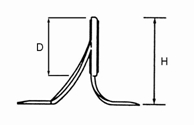
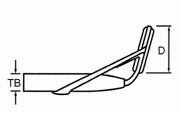
How Do I Measure a Rod Guide?
The Height is measured from the base to the top “H”
The Diameter is the size of the out side of the ceramic liner (not the frame) “D”
On Tip Guides the Tube Bore “TB” is the internal diameter of the tube this should be just a fraction bigger that the outside diameter of the rod blank to allow for some glue.
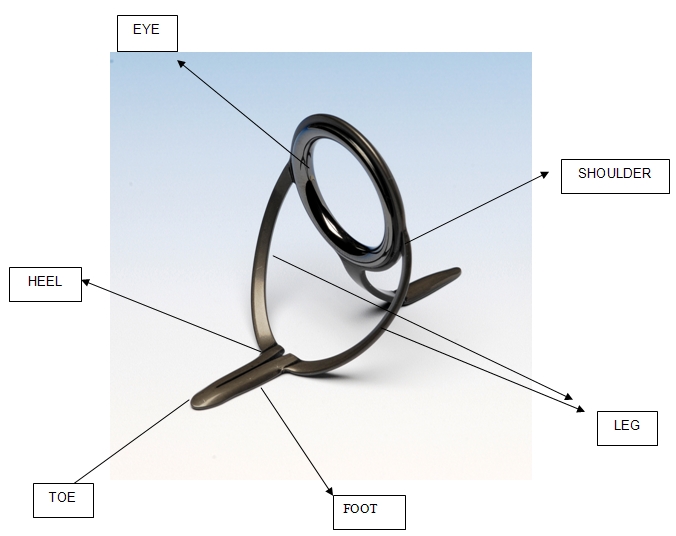
The Anatomy of a Rod Guide
Rod guide sizes & ID Size Comparison Chart.
| Size | Fuji Hard (O)centre BNOG , BSVOG etc | Fuji SiC -KWSK etc | Fuji SiC older type SVSG | Fuji Alconite | Fuji BNHG | Kigan | Alps | Minima | Seymo 243S,200S, 244S, 247S etc | SEYMO RDX, 406S | Fuji Heavy Duty BHNOG | Fuji Torzite |
| 2 | 2.6 | |||||||||||
| 3 | 3.2 | |||||||||||
| 3.5 | 1.7 | 2.11 | ||||||||||
| 4 | 2.1 | 2.2 | 2.2 | 2.44 | ||||||||
| 4.5 | 2.5 | 2.46 | 2.46 | 2.86 | ||||||||
| 5 | 2.9 | 3 | 3 | 4.9 | 3.47 | |||||||
| 5.5 | 3.5 | 3.5 | 3.5 | 4.08 | ||||||||
| 6 | 3.8 | 4.05 | 4.1 | 4.1 | 4.4 | 5.3 | 3.9 | 4.79 | ||||
| 7 | 4.5 | 4.7 | 4.8 | 4.8 | 5.5 | |||||||
| 8 | 5.3 | 5.63 | 5.6 | 5.6 | 5.2 | 6.1 | 6.1 | 7.1 | 5.3 | 4.7 | 6.42 | |
| 10 | 6.9 | 7.1 | 7.1 | 7.1 | 6.5 | 7.7 | 7.5 | 8.7 | 6.9 | 7.1 | 6.2 | 8.11 |
| 12 | 8.3 | 8.6 | 8.4 | 8.3 | 7.6 | 9.2 | 9 | 11 | 7.9 | 8.4 | 7.4 | 9.52 |
| 16 | 10.5 | 11.1 | 10.7 | 10.7 | 9.5 | 11.7 | 12 | 14 | 10.7 | 11 | 9.8 | 12.3 |
| 20 | 14 | 14.6 | 13.8 | 14.1 | 12.5 | 14.9 | 15 | 18 | 14 | 13 | 12.8 | 16 |
| 25 | 18.3 | 19.1 | 18.2 | 18.3 | 16.3 | 19.5 | 19 | 22 | 17.7 | 20.8 | ||
| 30 | 23.3 | 24.9 | 23.5 | 24.5 | 21.37 | 25 | 25 | 29 | 23.5 | 26.4 | ||
| 40 | 28.9 | 30.5 | 28.6 | 30.3 | 26.4 | 29.6 | 31 | 35 | 24.6 | 32.1 | ||
| 50 | 38.5 | 42.3 | 40.7 | 42 | 42 | 43 |
(ID shown in mm)
Downloads
Do you have any information about sizing guides?
Yes. You can download our sizing guides below.
A mm to 1/64 conversion chart can be found here.
Downloads
How do I return products to Guides n Blanks?
To ensure the safe return of any item whether it is faulty, sent to you incorrectly, ordered incorrectly or just unwanted. It is very important that you follow this procedure;
All items MUST be packaged in a padded envelope “Jiffy Bag” or boxed. All items must be sent back by recorded mail or carrier so that there is traceability.
We can not be held responsible for items that get “lost in the post” or that are returned damaged.
We will refund your postage charges if we are at fault.
If you no longer require an item we will refund you only the cost of the item not the postage charges.
For all overseas shipments, you will have to pay local tax/VAT and import duty before the carrier will deliver. If this is not done and the goods are returned to us we will be obliged to charge an additional shipping fee.
Please ensure that you include your name, address and a contact telephone number and the reason you are returning the item.
Returns should be sent to
Guides N Blanks
Unit 1 Abbey View Business Park
Pinvin
Pershore
Worcestershire
WR11 2FW
This policy in no way affects your statutory rights.
Do we export?
Yes we export globally, UK VAT will be deducted at checkout.
For all overseas shipments, you will usually have to pay local sales tax and import duty before the carrier will deliver.
Why are our guides so much more durable than our competitors?
All our guides are put through a vigorous abrasion testing machine. The diagram below shows the machine system layout, also displayed are the exact conditions for the testing.
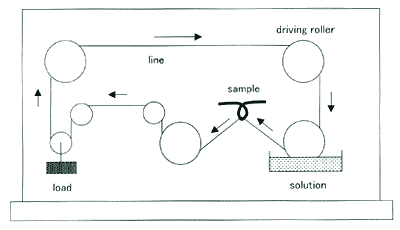
Condtions
| Line | nylon 9 lb line fly #4-DT-F line |
|---|---|
| Load | 700 g |
| Angle of line contact | 90° |
| Solution | 1% muddy water (mud 10g + water 1000ml) |
| Speed of line | 60 m/min |
| Distance | 3000 m |
For the following results two samples were identified:
- X SNG (PAC.BAY) Size 3
- 619AP - HC (SEYMO) Size 3
The above samples wer submitted to the laboratory for hardness determination of the chromium plating and coating thickness.
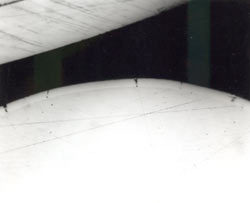
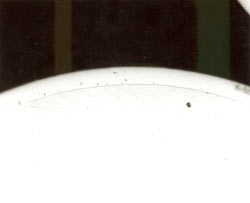
Coating Thickness
The coating thickness was determined in accordance with BS 5411 Part 5 (SGS Test Procedure E5TP 002.3). The measurements were made using the AMS 40-10 Image Analyser in accordance with SGS Test Procedure E5TP 002.13.
| Sample | Local Thickness (µm) | |
|---|---|---|
| Range | Average | |
| X SNG | 9.8 - 12.7 | 12.2 |
| 619AP | 18.4 - 25.8 | 21.3 |
The coating thickness of each is illustrated in Figures 1 an 2 (see below) respectively.
Hardness Testing
The hardness testing was determined on the prepared cross-section using the Leitz microhardness testing machine with a load of 100g.
| Sample | HV (01.) kg(µm) | |
|---|---|---|
| Range | Average | |
| X SNG | 874 - 891 | 882 |
| 619AP | 1064-1097 | 1081 |
| Coating of sample X SNG - Unetched (x400) | Coating of sample 619AP - Unetched (x400) |
|---|---|
 |
 |
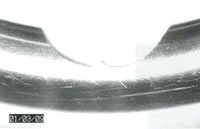
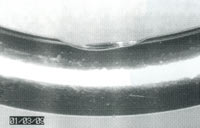
The photographs below show how the hardness of the chromium plating and the coating thickness effect the durability of the guide.
| Snake guide / Ti II wire (no treatment) | Snake guide / Ti II wire (tempering) |
|---|---|
 |
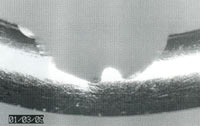 |
| abrasion wear: 323 µ m | abrasion wear: 439 µ m |
| Snake guide / plate ST wire with chromium | Snake guide / plate ST wire with chromium |
 |
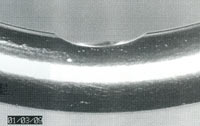 |
| abrasion wear: 86 µ m | abrasion wear: 101 µ m |
Condition
test line: fly line #4-DT-F
What impacts the use of 2 part epoxy and attaining good results?
Air temperature; work area temperature; curing area temperature; moisture content of the atmosphere; dust and other airborne rubbish settling on work; not using the correct mix ratio; not mixing sufficiently. Just because the finish is ‘touch dry’ does NOT imply it is fully cured!! Test many times to know your product before you start for real. If after a reasonable drying time the mix does not harden or cure you have not mixed at the correct part ratio.
Ceramic Centre Types what is the difference?
There are lots of types of centres but generally they can be split into 4 main groups based on the material they are produced from.
These are Porcelain, Alumina Oxide, Silicon Carbide and Titanium Nitride/cermet.
The biggest group by far is Alumina Oxide with different manufactures altering the colour and even adding coatings on top of the ceramic to alter the appearance.
| Name | Colour | Material | Hardness in Vickers |
|---|---|---|---|
| Fuji gold cermet | Gold | Titanium Nitride Cermet | 1100 |
| Fuji SiC | Silver/Black | Silicon Carbide | 2200 To 2400 |
| Fuji Alconite | Black | Reinforced Alumina Oxide | 1300 To 1500 |
| Fuji Hardloy | Grey | Alumina Oxide | 1200 To 1400 |
| Fuji Hard | Dark Grey | Alumina Oxide | 1200 To 1400 |
| Fuji "O" | Dark Brown | Alumina Oxide | 1200 To 1400 |
| Seymo Superglide | Brown | Alumina Oxide | 1200 To 1400 |
| Seymo Hardlon | Dark Brown | Alumina Oxide | 1200 To 1400 |
| Seymo Titania | Grey | Alumina Oxide | 1200 To 1400 |
| Porcelain | White | Porcelain | 550 To 650 |
All of these centre types have there own benefits, and all the centres will handle mono fishing lines. If you use braded lines we recommend that you use Alconite, Sic or Cermet. But be warned there are lots of copy products like this, where a softer alumina centre has simply been painted or chemically plated to make it look like Sic or Cermet. It pays to buy a branded product.
Which are better Snake Guides or Lined Guides?
This is a commonly asked question, and at the end of the day it is down to the individual angler, how they fish and the type of fishing they do. Lined guides especially Fuji or Seymo will not grove as fast as a snake guides, but the surface area of any lined guide is much greater than a snake guide so this will increase the friction and reduce the length of line cast. It is a trade off, but be sure to use H&H snake guides as they are by far harder, than all others on the market.
DLC, TIC, and TIN what is it and how long does it last?
All of these are different types of coatings that H&H can put onto their range of snake guides and tip tops. DLC = Diamond Like Coating, This is a titanium nitride coating, during the coating process Argon gas is added to give the black/blue finish.
TIN=Titanium Nitride Coating is exactly the same as above but without the argon gas this leaves a gold finish. TIC= is the same but has an ebony gun smoked finish. All of these treatments were originally developed and used to coat drills, machine cutters and bearing parts to give a lower coefficient of friction and improved ware resistance.
IN all of the finishes H&H take their Hard Chrome snake or tip top and then have this coating applied to it. Why? Because it gives a very hard substrate for the coating to adhere to. It is best related to a pond that freezes over in winter, if you take a hammer and hit the ice you will smash through. However if you take a small amount of water and pour it onto a road , that freezes , you hit it with a hammer , the hammer will bounce off because of the hard substrate, That's why H&H put these types of finishes over hard chrome , Unlike Pac Bay who coat directly onto the bear wire. This also means that if the coating does were off you are safe in the knowledge that you have hard chrome underneath.
Do the rod blanks carry a life time warranty as some Rods do?
All the Rod blanks we sell are covered against all manufactures faults and Defects. Obviously the workmanship done on a rod blank is not warranted in any way.
Downloads
What is the difference between English pattern & American Pattern snake Guides?
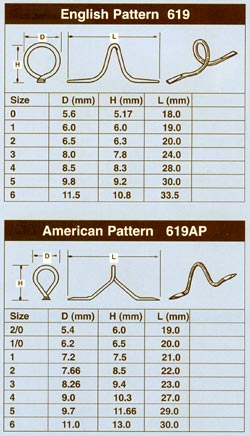
In terms of raw materials and hard chroming of the guides there is no difference, the difference is all down to the shape or form of the guide. An American pattern is coiled left to right, it has straight legs and stands off higher. The English pattern is coiled right to left and is round in profile with sweeping legs, it is also a lot lower set.
In years of practice we have found that an English pattern is better suited to a softer, slower action blank than an American pattern which is by far better on a fast action blank. We proved this theory by putting American pattern snakes onto a soft slow action blank in a relatively short time of use the inside legs were showing sign of ware and in fact the Epoxy on the whippings were actually grooved, We changed the guides back to English pattern and tested again, over the same test period no ware was detected.
Dimensions of English and American pattern Snake Guides
How do I assemble the Rodsmith Quad Dryer
Download the following file.
Downloads
Is there any more information about the Rod Smith Power Wrapper?
Yes. You can download our Power Wrapper PDF below.
Downloads
How do I use a Pac Bay Rod Drying Machine (RDM-1)
Download the operating instructions for the Pac Bay Rod Drying Machine below.